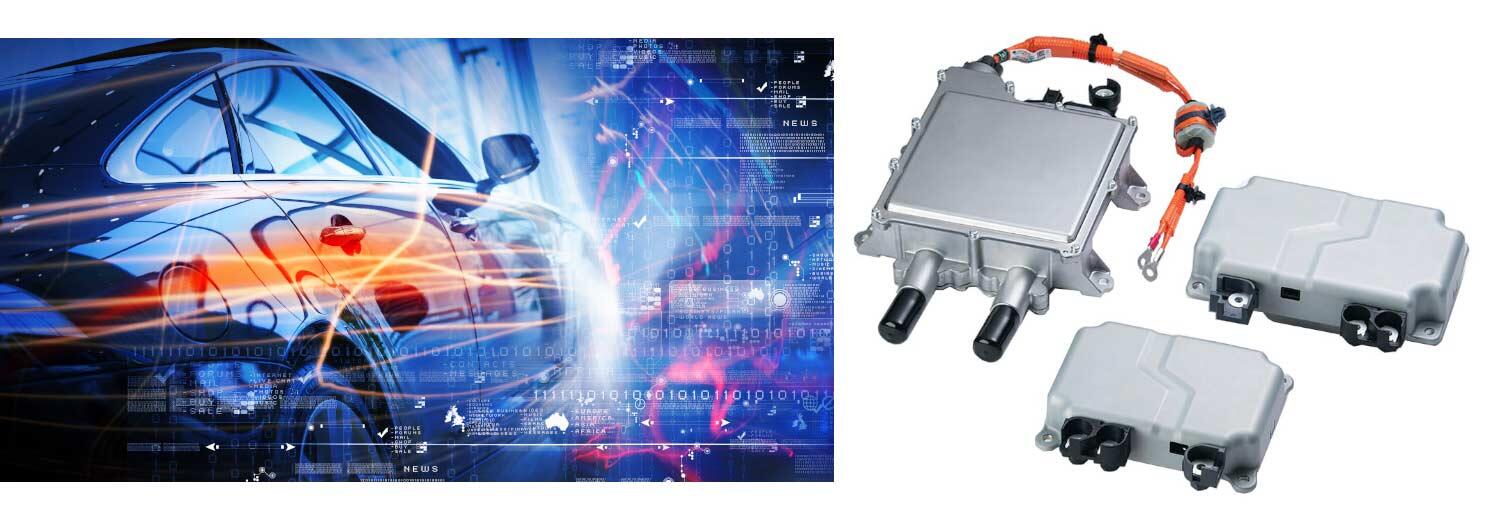
Fuel consumption and exhaust gas regulations are being enacted in various countries and regions in order to reduce CO2 emissions as a means of preventing global warming, and the propagation of environmentally friendly vehicles (EV, HEV, FCV) which can drive cleanly using electric motors is increasing as a result. These vehicles most commonly use systems where power from high voltage batteries which serve as the energy source for the electric motor is converted to low voltage battery power, and DC/DC converters are the devices which are used to carry out this power conversion.
In addition, as the number of vehicles equipped with advanced equipment, such as automated driving systems, continues to increase, the step-down DC/DC converters which allow for stable, continued operation of these functions, are becoming an ever more vital and important component.
What are Electric Vehicles?
Vehicles which operate using electricity as their primary energy source and which can accelerate smoothly through use of an electric motor.
What are Hybrid Electric Vehicles?
Vehicles which operate using both gasoline and electricity as their primary energy sources and which feature beneficial characteristics of both engines and motors.
What are Fuel Cell Vehicles?
Vehicles which drive using hydrogen as a fuel, and which drive using the power generation which occurs during the chemical reaction between hydrogen and oxygen as a power source.
Features
As automotive electronics continue to make advances, there is an increasing demand for powering electronic components. Now vehicle mounting designs, for example, also require inverters, motors and high-voltage batteries, and they have become more high-density with each generation. As a result, the power capacity must be increased for DC/DC converters, and they must be downsized further and made more lightweight. To address these expectations, Shindengen offers low-loss from soft switching circuits, as well as high heat dissipation and thermal dissipation technology. In addition, full digital control with a DSP (digital signal processor) helps optimize power control, strengthen safety designs and enable communication with the controlling ECU. The DC/DC converter has the advantage of being able to combine specific circuits and components to support various vehicle cooling methods using one of the following three types: forced air cooling type, non-waterproof and waterproof water cooling types.


Step-Down Insulated Converter (1kw output)

| Use | For HEVs, P-HEVs, EVs and FCVs |
|---|
An insulated type DC/DC converter which can convert power from high voltage batteries to low voltage batteries with high efficiency.
Because it is compact and has low output capacity, it can be used as the main converter for compact electric mobility devices or as a sub-converter for constructing redundant systems.
Specifications
The following specifications of input voltage range are avaible.
| Input voltage range |
240V - 415V (Other input ranges under development) |
|---|---|
| Output voltage |
12V system : 10 - 15.5V 24V system : Under development |
| Output current rating | 75A |
| Cooling type | Air cooled or water cooled |
| Features | Compact Maximum conversion efficiency 93.5% |
Step-Down Insulated Converter (2kw output)

| Use | For HEVs, P-HEVs, EVs and FCVs |
|---|
An insulated type DC/DC converter which can convert power from high voltage batteries to auxiliary batteries with high efficiency.
Because it is a high capacity product, it can be used as the main converter for electrified vehicles.
Specifications
The following specifications of input voltage range are avaible.
| Input voltage range |
180V - 310V (Other input ranges under development) |
|---|---|
| Output voltage |
12V system : 10 - 15.5V 24V system : Under development |
| Output current rating | 150A |
| Cooling type | Air cooled or water cooled |
| Features | Maximum conversion efficiency 94.5% |
*System usage examples

Waterproof, Step-Down Insulated Converter
| Use | For HEVs, P-HEVs, EVs and FCVs |
|---|
This waterproof, insulated DC/DC converter with water cooling converts power with high efficiency, ranging from high-voltage batteries to low-voltage batteries (12 V).
Specifications
The following specifications of input voltage range are available.
| Input voltage range |
Input[Standard]:DC180V~DC310V |
|---|---|
| Output voltage | 7–16 V |
| Output current rating | 150 A (rated value) and 175 A (maximum) |
| Cooling type | Water cooling |
| Features | Maximum efficiency 95.4% |